
The market for quality management system software (QMS software) is developing rapidly. New regulatory requirements, increasing pressure to innovate, and global supply chains make structured, digital quality management a strategic necessity.
At the same time, choosing the right software is becoming increasingly difficult. The current Gartner® Magic Quadrant™ for Quality Management System Software offers insights in this area. But what does it actually say about the market, and what does that mean in concrete terms for companies evaluating a QMS?
A billion-dollar market with strong growth
The QMS software market is experiencing rapid growth. Gartner projects that the global QMS software shortlist will surpass $10 billion in 2025, representing a 26% increase over 2024 (up from a 22% year-over-year growth rate between 2023 and 2024). In our view, this momentum underscores both the growing demand for powerful quality management systems and the continuous development of providers.
For companies, this means that choosing QMS software is no longer purely an IT decision, but rather a strategic investment in future viability, compliance, and competitive strength.
Cloud-native as standard: Software as a Service is gaining ground
Cloud-based SaaS models have now established themselves as the leading standard in the market for quality management system software. According to Gartner, SaaS deployments now account for approximately 85% of all implementations.
We believe the reasons are obvious: faster deployment, better scalability, lower IT operating costs, and a shorter overall payback period. For many companies, the cloud is therefore no longer just an option, but the strategic standard for modern QMS infrastructures.
This shifts the focus from pure system provision to topics such as speed of innovation, continuous updates, and long-term technological development.
AI as a key differentiator in the QMS market
While classic QMS core functions are increasingly considered standard, providers are investing more heavily in the expansion of AI-supported functions, automation, and advanced analytics. The goal is to clearly differentiate themselves from each other technologically and create additional value.
Key developments include:
• AI-supported CAPA and audit processes
• Predictive risk assessments
• Automated workflows to reduce manual effort
• Self-service analytics for specialist departments
In addition, the roadmaps of many providers show a strong focus on dialogue-oriented AI and agent-based assistance systems. These are intended to guide users through complex quality processes in the future and enable proactive, data-based decisions.
Seamless integration as a prerequisite for holistic quality management
A modern QMS only unfolds its full benefits when it is seamlessly integrated into the existing IT landscape. Consistent data flows and transparent information in real time thus become key success factors.
Providers are continuously expanding their QMS platforms to enable smooth connection to a wide range of enterprise systems, including ERP, MES, LIMS, CRM, PLM, EHS, DMS, RIMS, and HR, as well as other third-party applications.
Key findings from the report for decision-makers
We feel the 2026 Gartner® Magic Quadrant™ for Quality Management System Software provides a structured basis for comparison for companies that want to evaluate QMS software or further develop their existing platform.
Gartner analyzed 12 international providers based on 15 weighted criteria, including market understanding, innovation capability, offering (product) strategy, implementation strength, and customer experience.
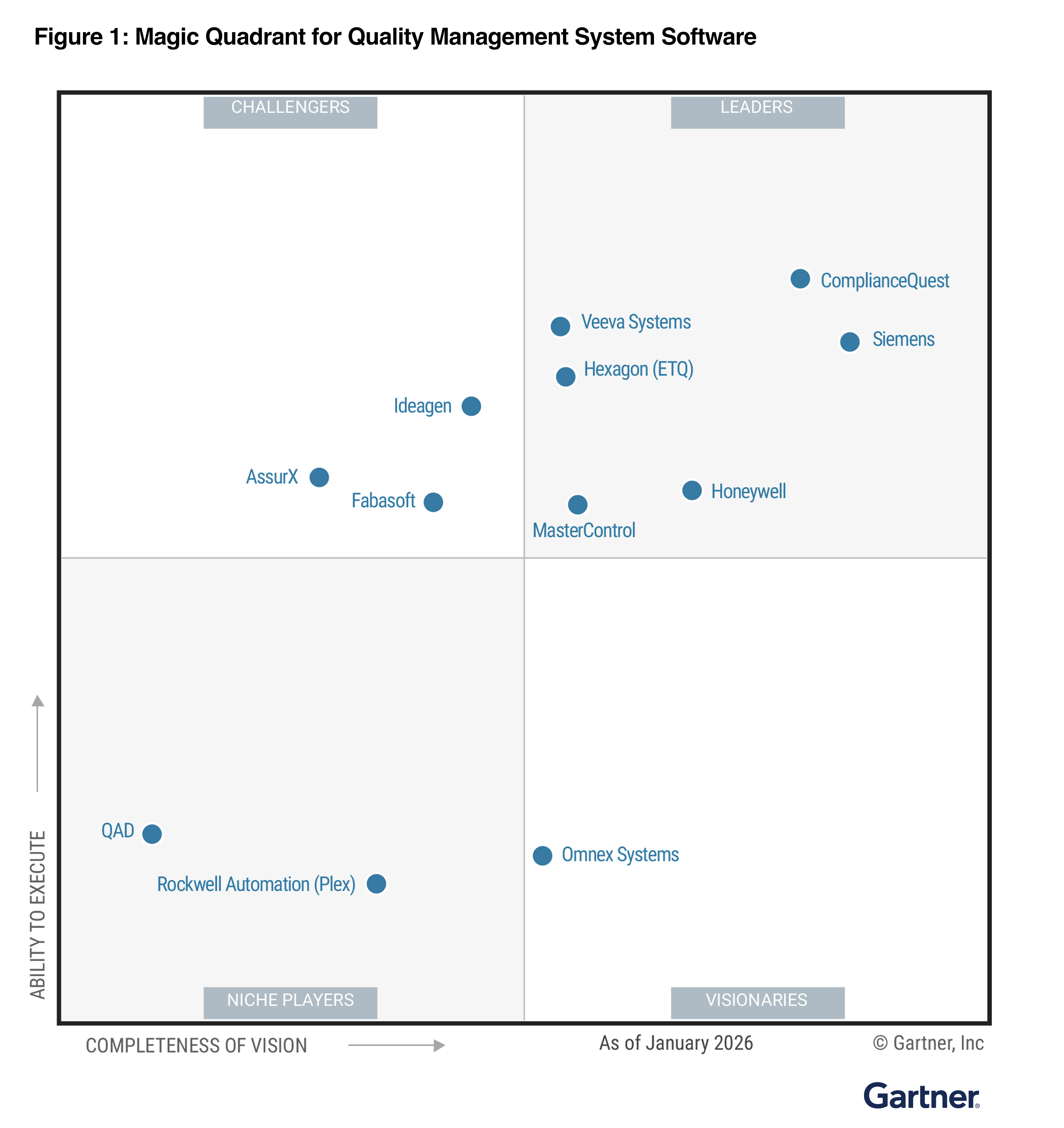
In our view, Fabasoft is represented as a European provider with Fabasoft Approve and impresses with AI-supported document and quality management specifically for industrial requirements.
We believe that inclusion in the Magic Quadrant is already considered a recognized mark of quality due to the strict evaluation methodology. For companies, however, we feel it is not so much the specific recognition that is decisive, but rather the question of which provider best supports their own pain points, industry-specific requirements, and strategic goals.
Fabasoft as a Challenger in the 2026 Gartner® Magic Quadrant™
In the 2026 Gartner® Magic Quadrant™ for Quality Management System Software, Fabasoft is positioned as a Challenger. The report mentions Fabasoft Approve, the AI-supported software for document and quality management.
We believe Fabasoft Approve supports companies in managing quality-related processes in a structured manner, minimizing risks, and reliably meeting compliance requirements. Intelligent automation, transparent workflows, and high traceability create efficiency and security, especially in regulated industrial environments.
In our opinion, Fabasoft is the only European software manufacturer in the Magic Quadrant that focuses on mechanical and plant engineering. This focus is particularly relevant for industrial companies that have high IT security requirements with data storage in Europe, compliance, and regulatory conformity.
From market analysis to strategic decision
The Gartner® Magic Quadrant™ offers companies insights in a complex competitive environment. However, the decisive factor in selecting a suitable QMS is which software best supports your own quality objectives, regulatory requirements, and industry-specific challenges.
Those who want to future-proof their quality management in the long term should not limit themselves to comparing providers and functions, but should also consistently consider strategic compatibility and technological development.
Gartner, Magic Quadrant for Quality Management System Software, Hope Warrilow, Kate Wagner, 20 January 2026
Gartner does not endorse any company, vendor, product or service depicted in its publications, and does not advise technology users to select only those vendors with the highest ratings or other designation. Gartner publications consist of the opinions of Gartner’s business and technology insights organization and should not be construed as statements of fact. Gartner disclaims all warranties, expressed or implied, with respect to this publication, including any warranties of merchantability or fitness for a particular purpose.
This graphic was published by Gartner, Inc. as part of a larger research document and should be evaluated in the context of the entire document. The Gartner document is available upon request from Fabasoft.
Gartner and Magic Quadrant are trademarks of Gartner, Inc. and/or its affiliates.