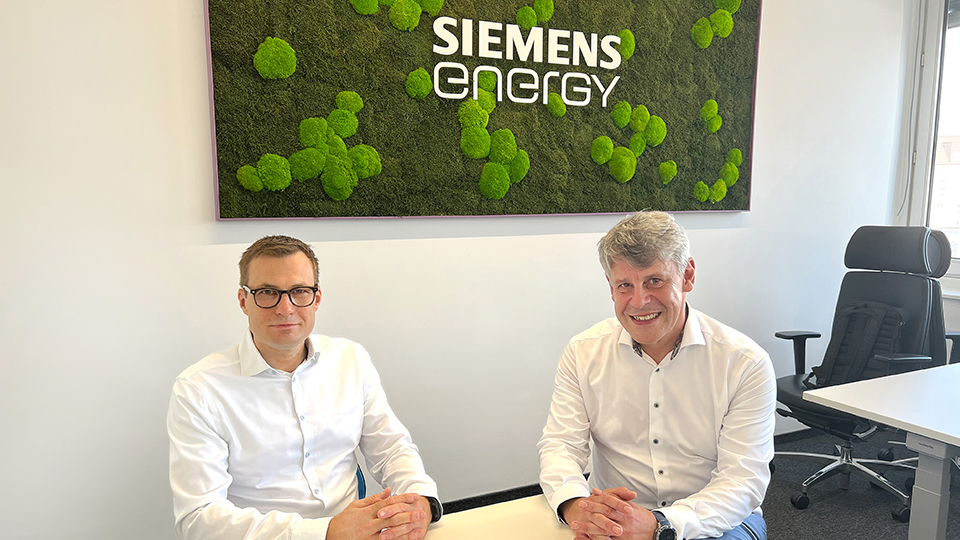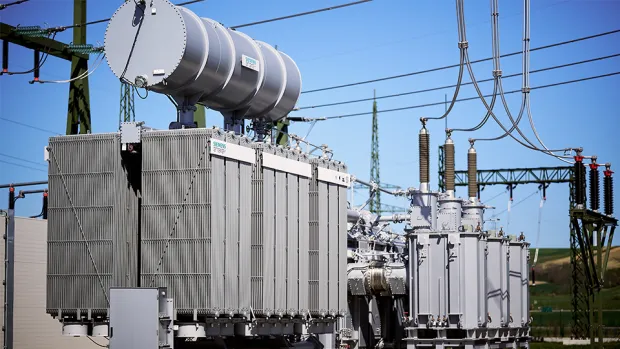
Everyone is talking about digitalisation and AI. But how far has the industry really come? Martin Sigmund, Vice President of Medium Power Transformers Europe at Siemens Energy, is responsible for manufacturing sites in Linz, Dresden and Trento. Andreas Dangl is Managing Director of Fabasoft Approve GmbH, the quality and document management division of the Fabasoft Group. A conversation about connected processes, European software and AI that is making a practical impact.
Mr Sigmund, you wrote in a LinkedIn post: “Without our transformers, there is no AI.” Does that change your company’s perspective on its own digitalisation?
Martin Sigmund: The global demand for AI and data centres makes the role that transformers play in critical infrastructure even more apparent. This also raises our standards for our own processes. For me, digitalisation isn’t about introducing yet another tool, but about simplifying workflows, making information usable and speeding up decision-making. Innovation only counts when it is put into practice.
Mr Dangl, you see every day how companies such as Siemens Energy are digitising their processes. Where do things most often go wrong – technically or organisationally?
Andreas Dangl: It’s rarely down to the technology. The real problem is scaling the initiative across the board. Particularly when it comes to AI, it’s tempting to design a complex system, implement a flagship project and, in doing so, forget that achieving widespread benefits is hard graft. That is precisely our aim: to tackle this work together with the customer in order to actually realise the full return on investment.
Siemens Energy works with a global network of suppliers, partners and customers. How do you manage cross-site document and quality processes?
Martin Sigmund: I’m speaking here on behalf of our transformer business in Europe – which has around 950 employees at our sites in Linz, Dresden and Trento. The demands are high; we have many partners, interfaces and documents. Our approach is clear: moving away from file shares and siloed solutions towards harmonised digital processes, across all sites and within standardised structures. For us, digitalisation is a success when it makes work easier, faster and more reliable. That was also our starting point with Fabasoft.
Andreas Dangl: The real challenge lies with the company itself. Siemens Energy is currently undertaking a massive standardisation effort across its plants, from Italy to Germany. This is also a competitive issue. If plants are to collaborate across sites, documentation must also function according to common standards. This requires harmonised digital structures, and that is precisely where Fabasoft Approve helps.
What specific results have you achieved by using Fabasoft Approve?
Martin Sigmund: In Linz, we have integrated specific file-sharing areas into harmonised structures. For new projects, we use standardised filing structures across all sites. In day-to-day operations, this means: clear processes, transparent approvals, and significantly less time spent searching for files and coordinating. We do not measure individual key performance indicators in isolation. For us, digitalisation is not an end in itself, but a prerequisite for remaining more efficient and competitive. This is strategically crucial, particularly when compared to regions where industrial scaling takes place much more rapidly. Information security was also a key factor. Standards such as ISO 27001 serve as a relevant benchmark in this regard. European systems align well with our standards of reliability, compliance and digital sovereignty. Our business has a strong international focus, and our customers also value reliable, secure and traceable digital processes.
How is AI changing the requirements for documentation and quality management? Does it take the pressure off teams, or does it create new complexities?
Andreas Dangl: We are currently working together on a specific AI project: customer specifications for new transformer projects are automatically extracted, analysed and converted into a data model, enabling us to prepare quotations much more quickly. This involves 40 to 50 parameters, for which experts currently have to manually work through hundreds of pages of specifications. AI can do this faster, more reliably and around the clock. The business benefit is directly measurable.
Martin Sigmund: Although it is even more complex than that. Customer specifications range from 20 to over 1,000 pages; documents cross-reference one another, and details can be contradictory. The software must understand this, extract relevant parameters and, in cases of ambiguity, actively alert the user. What is important here is that AI must be meaningfully integrated into the solutions we use in our day-to-day work. We cannot be specialists in every field ourselves – the key is to work with the right partners to incorporate technology into our processes in such a way that it generates industrial impact. What we used to do manually in the past, based on expert knowledge, can now be largely taken over by AI, which can also link insights from parallel projects and historical data. This is the decisive competitive advantage over traditional working methods. And this is only the beginning: our vision is a fully digital end-to-end chain, from specification through to engineering
What is your personal prediction: which topic will dominate the debate on industrial digitalisation in two years’ time?
Andreas Dangl: AI is here to stay for a long time to come. We are still a long way from fully realising its potential. The initial hype has passed, and we have entered a sort of ‘trough of disillusionment’. The focus now is on professionalising AI and truly rolling it out on a large scale.
Martin Sigmund: I see it in a similar light. In two years’ time, we will no longer be talking about digitalisation as a buzzword, but rather about whether we are generating scalable, industrial-scale impact. AI must be linked to productivity, speed and implementation. To achieve this, we need to be bolder, think more futuristically and approach processes in a more consistent, disruptive and highly automated way. It is crucial that we make digitalisation and AI a management priority, rather than simply embedding them somewhere within the organisation and hoping for the best. Digitalisation is only successful if it has an impact on the shop floor and on people. The future belongs not to the loudest promises, but to the most effective results.